Tuesday, May 31, 2022

Shapes in the Shadows


Sometimes I think I see things moving in the water. I think I see shapes churning in the shadows behind the boat and wings unfurling just beneath the bow. Other times, I think I see forms reaching out of the waves on the horizon.

The glances I have of these forms are always short-lived—just fleeting motions like swallows darting across the sky. The forms initially appear to me as birds or whales, and I try hard to define them, but when these initial forms fade, I’m left staring out over the open ocean again, wondering if I’d seen anything at all—wondering if it was just a trick of the light.

It’s been challenging, during these last few weeks, to adapt to the constant transitions of life at sea. I’ve felt a steady wind of emotions that have, at times, left me feeling unsettled. My body’s responses to the sea have not always been kind. Periods of work and rest happen at odd intervals, and consistency has evaded me completely. Every moment is a moment of transition. Moments are never quite aligned—never quite full or regular or part of something that falls into place.

As we reach the end of our passage, I find it difficult to define myself in this period of constant transition. But, in the uncertainty of being undefined, I’ve grown to feel some freedom. It’s a form of relief to be unbounded and intimately at the whim of something greater. Here, I am separate from my habits and the comforts of my life on land—I am separate from myself, in a way, and the constraints I impose on myself.

As I’ve grown more comfortable here, I’ve started to see the moments that blossom in the transitory light. I feel the warm hands on my back comforting me, the pride in my growing callouses, and the power of being at the helm of the ship. I’m embraced by that soft and rich orange color of the early morning light. I’m entranced by the waves at night that live in a black and white haze of motion. And I’m captivated by the visitors we receive, which, while few, are of immense beauty—the passing clouds, the quick but forceful squalls, and the sea birds that swirl around our boat.

I’d like very much to define this time for myself—to abstract it away into some line that I can relay to my friends or some blurb for my resume. I’d like, too, to be able to capture the moments of light I feel so deeply that live in this boundless space. I’d like to hold the songs sung under a blaze of stars, the sleep deprived smiles, and the little moments of peace for as long as I can. But I have as little luck in capturing the moments of light as I do in trying to make out shapes in the ocean—or in trying to hear my name in the movement of the wind. It all eludes me.

So, I’ve settled, for now, on savoring the light as it passes.

Diego Rafael Perez

Saturday, May 28, 2022

A Great Oceanic Eye

Sometime after midnight, bioluminescence comes into full bloom. Flecks of dinoflagellate-produced light flicker on the inky waves, disappearing as quickly as they appear, like a magic trick, a wink, a blink of a great oceanic eye. During my last dawn watch, I paused for a moment as force 4 winds blew in from the southeast, sending whispers of stratocumulus clouds across the sky. A set of steep stairs took me down into the red-lit charthouse, and I braced my legs against the rolling ship, the handrails I helped re-tighten with the engineers two weeks ago still solid under my grip.


It’s strange how accustomed we’ve all become to this ship, to this place that is both voyage and home, how quickly we’re getting used to six-hour watches separated by twelve hours of sleeping, eating, and whatever else we can fit in. Nothing stays still on this ship. Things spill, tip, and fall over all the time. Bodies collide, sometimes with metal or wood, oftentimes with each other.

Our days are marked by the time we wake and the time we go to sleep. Sometimes we close our eyes and sink into our bunks when the sun is just rising and wake up at a different latitude, rain pouring down on the quarterdeck. Another ITCZ squall. We eat our meals on gimbaled tables and seem to know—most of the time—where to put our elbows, a plate, a bowl of sloshing soup. There are days when we forget where we are and it’s okay. We learn to patch up our wounds, let our bruises heal, clean up our messes with multicolored microfiber towels from the closet.


And yet what I find strangest of all is how everything at sea is at once a contradiction: beautiful and hard, time suspended and time flowing, everything moving as water does, inconstantly and infinitely.

Crossing the Pacific, the ocean becomes a sound, a smell, a swell, a memory, a curse, a tease, a song, a burning blue. It calls upon a system of inhuman time, cycles of unknowable depths and immeasurable wonders, a pelagic mystery, an alien universe. Over these past three weeks, the ocean has constituted, at least for me, both journey and destination, beginning and closing, new and old patterns of who I thought I was and am, all coursing over the pour of liquid distances.

The philosopher Søren Kierkegaard once wrote that “Life can only be understood backwards, but it must be lived forwards.” Whether or not Kierkegaard ever spent much time on a tall ship like the Robert C Seamans, I’ve been coming back to this quote as I realize how hard—and perhaps impossible—it is to reflect on an experience as it’s happening. Instead, what we end up understanding about a time or experience becomes understood afterwards, when connections coalesce from scattered dots of observation and patterns of perception become a line, a circle, a spiral, a shape. Certain moments, interactions, and encounters take a form and color as intense and inconstant as the shifting sea.

So what can one say?

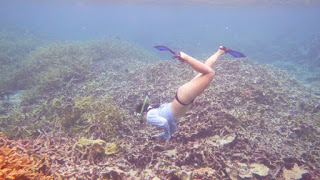
I suppose I could talk about the first time I dove into the coral reefs at Palmyra Atoll with my lovely friend and research partner Jessie.

Beneath the teal tropical waters, we swam through a world composed of streaks of motion—triggerfish, tangs, blennies, sharks, mantas, and parrotfish chomping on the corals. Jessie and I deployed three hydrophones across the coral reefs at Palmyra for our bioacoustics project, recording over one-hundred and fifty-six hours of sounds. Camille, our TA and project mentor, nearly wept as we huddled around her laptop the next evening and passed the headphones around, listening to a chorus of crepuscular fish calling into the coral midnight.

I suppose I could also talk about how I’ve come to love the glow of a sunrise over open ocean. Or how, during the few hours before twilight, breaking waves sound like soft breaths punctuating the quiet night. Of course, among these moments of beauty are the more difficult ones, too, like finding a way to make peace with stubborn layers of sea and sweat on the skin, a persistent queasiness in the stomach, a dull longing for loved ones on land. We take so much for granted that only when some things are stripped away do we see how much they mean to us.

A year ago, I was working as a wooden boatbuilding apprentice in midcoast Maine. I wore brown Carhartt overalls which became stained with varnish and emerald marine paint. Despite hundreds of hours of working with boards of pine and cedar, chiseling and restoring various sailboats, canoes, and dinghies, I never got to see what ultimately became of them, where they ended up going, what they saw, whose lives they intercepted.

I certainly never imagined that I would be where I am today, writing to you from a tall ship in the central Pacific Ocean. Did the makers of the RCS think about all the students it would carry, all the places it would go? What kinds of understanding it would bring forth?

The first time I climbed aloft onto the mainmast, I found myself high above the birds circling around the ship. I paused as I made my way to the top, looking down on everyone below me moving between watches, between tasks, between moments. Everyone on this ship, from the captain to steward to engineers to mates to scientists to students, contributes in their own way to this voyage and experience. We are each and all part of something greater than ourselves, moving forward, moving with the rhythm of the sea.

In his night orders to the evening and dawn watches, captain Greg writes a message with instructions for the night, reminding us always to remain vigilant and alert. Being vigilant and alert are critical to maintaining the safety of the ship, and to these, I would also add remaining patient, brave, and above all, kind.

Our voyage is mostly behind us, but there are still a few more precious, difficult days ahead of us as we sail back to Honolulu. If life can only be understood backwards, then it must be lived forwards, just as our ship propels itself forwards in accordance with the winds and weather, invoking forces much more powerful than our individual selves.


-Regina Kong
Bottle Overboard!

Maitri

It was a quiet morning aboard the Robert C. Seamans. Following a night of squalls, we were drifting near Kingman Reef, awaiting Captain’s orders on where to go next. After finishing up morning chores, I was tasked with being on bow watch, which entails keeping a sharp look out for any signs of traffic or foul weather. The sun had just risen, casting a fiery glow on the steely gray waters around us. I clipped into the bow and took in my beautiful surroundings. As I began humming a song, I leaned over ever so slightly to look at the sun’s reflection on the water. Suddenly I felt something snap. To my utter dismay, I realized that my water bottle, which was clipped into my harness, had broken loose of its string and fallen past the bowsprit straight into the ocean. I watched the hunk of red metal bob up and down and then begin to lazily drift along the port side of our boat. I quickly informed my watch officer Vuk of the situation and soon a group of my shipmates had gathered with a fish net valiantly attempting to scoop my bottle out of the water. But alas, the net fell a mere inch short and soon the bottle was completely out of our reach. As people began to give up and leave, Vuk said with a grave tone, “You have to let it go, Maitri,” and as if to rub (sea) salt into my wounds, added “Don’t do that again.”

Water bottle-less and defeated, I returned to the bow to resume my lookout. Since we weren’t sailing or motoring, I spent the next hour hopelessly watching my water bottle drift further and further away with the current. I reflected on my history with the bottle. Years ago, my mother gave it to me back home in India. The bottle travelled with me halfway across the world and together we experienced grueling college classes, hikes, beach days, tumbles into waterfalls with friends, camping trips, and most recently, a seafaring voyage across the Pacific Ocean. And now, it seemed my water bottle was ready to embark on a solo adventure. With my shipmates’ support, I began to imagine what its future would look like. Maybe it would sink to the bottom of the ocean and become the new shell of a gigantic hermit crab. Maybe it would wash ashore some remote island and be discovered hundreds of years from now by archaeologists who would use cutting-edge technology to decipher the tattered sparkly stickers on the bottle, reading “Of Course I’m a Feminist!” and “Go with the Flow.” Maybe it would be found by someone who had been stranded on an island for days and the freshwater in it would hold them over until their rescue helicopter arrived. At the end of the hour, I had somewhat come to terms with my loss. My role for the next hour was as helmsperson and I quickly swung into action as the Captain gave us new course orders. As I began to turn right, a glinting light in the ocean caught my eye. Was it just a wave crest? A trick of the light? I stared at the glint again and, could it be?

“It’s my water bottle!” I exclaimed.

Tanvi

After a long dawn watch shift, I had stayed to watch the sun spread over the sky while my beloved crewmates from A Watch took the helm. For the last hour, I had seen the grief in Maitri’s eyes as she mourned the loss of her water bottle. More than a container for fresh water, the distinctive red water bottle had come to symbolize so much more in its association with Maitri – a symbol of progressive ideology, a reminder of her love for the ocean, a key support for physical health. I had admired, too, how bravely Maitri had moved on from the bottle’s tragic demise, taking helm even through her pain. Maitri, who had given so much to us all in the last three weeks, had lost something important today.

When I heard her cry, I knew this was my chance to finally give back to Maitri, the boat’s font of generosity. Springing into action with my instincts honed from all our man overboard drills, I scanned the horizon for the water bottle till I saw the red spark that had drawn Maitri’s eye. I raised my hand and pointed at it. In the background, I heard Maitri beg Vuk to return for her water bottle. Finally, the stern Serbian relented and gave the fated order: “Ten degrees right rudder.” I kept pointing as the boat began to turn – back towards the water bottle, back towards hope once more. Even though my arm began to ache, even though my eyes burned with the sun, even though the three feet swells threatened to hide the bottle from view forever, I kept my whole body trained on the bottle. Steadfast crewmate Jessie kept my company even as our muscles burned. I called on all my training as a designated spotter in an emergency situation to keep me going.

I saw the bottle shift towards our port side and keeping a visual fix on where I’d seen it last, I sprang into action towards the science deck, the only place in the boat low enough to fish the bottle from the water with a net. There, I joined the esteemed JP and Nate Bears, engineers extraordinaire, already prepared with nets for retrieval. With bated breath, we watched the bottle bob towards us. It glinted in the sun. With the chaotic, turbulent waters of the ITCZ, every swell threatened to take it further away from us, not closer. But I kept hope because I knew everything the bottle meant. Finally, it came just close enough and with a mighty swoop, Nate scooped it from the water in one deft motion with a Zen-like calmness honed through his 5 am breathing exercises. He triumphantly held the water bottle aloft, plucked from Davy Jones’ blue clutches, and from the quarter deck I heard Maitri utter a shriek of victory. I could feel the joy in her heart and I was honored to have been a small part of it.

Quotes

“You know, ‘I said in jest, oh Maitri, you should go on helm and steer us to your water bottle, haha’ and then, she did” – Dakota

“Clearly if a man goes overboard, they can be saved”

“Maitri should not be trusted with a small child that is water bottle sized at bow watch” – Camille

“This is the best steering I’ve seen from Maitri the entire trip. A fine display of bottle, ship, shipmate, self.” – Shaili

“It’s symbolic of something.” – Regina

“Don’t make this a big deal.” – Captain Greg

Friday, May 27, 2022

How Big Is the Ocean?

On a boat headed nowhere, we begin to talk about teleportation. It’s dawn watch, the six hour shift from 1 am to 7 am where the largest event is watching the first lights come to the horizon and the stars wheel out of sight, and we’re two days’ sailing away from Palmyra Atoll and hovering a few miles away from Kingman Reef. There’s more science to do here, more things to uncover in the water, and our only task tonight is to remain within a set box on the map. The Intertropical Convergence Zone has dipped down to our latitudes and the seas have flattened out. An hour ago we gave up on steering and left the helm to itself so our watch can gather on the quarterdeck and drink tea (or, in my case, my latest attempt at improvised hot chocolate – hot water, nondairy creamer, and a spoonful of Nutella). The engine’s off and the sails are down and we talk in low voices while the boat drifts through the equatorial Pacific.

We talk about what super power we’d choose, given the choice, and someone suggests teleportation. Wouldn’t it be cool to Apparate (“Wait, guys, what’s Apparation? I don’t get it,” Lilah says) from place to place with just a thought? I’m surprised at how viscerally I reject the idea. Two weeks away from Honolulu, the two flights I’ll have to take to get home are becoming more real before me, and the many journeys beyond that to get where I’ll need to go. Everything would be easier if I could disappear somewhere, reappear somewhere else. But embedded in the question of teleportation is also the question of why we’re here, now, on a boat with no direction. A flight to Palmyra is two hours and we spent two weeks travelling the same distance. In every nautical mile we cover, the aphorism echoes: the value is in the journey, not the destination.

But what has it meant to go somewhere out here? I expected to spend every second on the boat overawed by the size of the ocean and its vast unknowability. Instead I’m surprised at now, three weeks in, how familiar it all feels. Rather than a foreign expanse, the waves until the horizon feel almost intimate in their companionable repetition. Each swell is framed within the same metal poles of the awning, the netted triangle of the bowsprit, the curved hull of Gene, the curved shape of Wayne’s World, the fishing poles on the quarterdeck, the contours of the tubas, the large cream wings of the sails in their various configurations –the stays’ls, double-reefed main, the jib, the jib tops’l, or all doused, the sails rising and falling with the wind around us – the ocean is drawn out for us, always, in the outlines of the boat we’ve circled hundreds of times in the last three weeks and have sweated on and cried on and laughed on and sung on and grown to live and love in so many ways. When I come up on deck every morning and go to the rail and look out (morning being a relative term, defined at any time between the hours of 1 to 11 am), it’s not awe I feel but a rush of quiet recognition. Oh, it’s you again. The horizon-line is a belt cinched at our waist, as much a part of our vessel as the wood of the helm.


How do we know we’re going somewhere at all? If not for the numbers we collect every hour in our boat and science checks, with the evidence of our minds and bodies there’s only the subtlest of signals: our shadows switch directions as we pass from one side of the sun’s ecliptical to the other. The Southern Cross fixes itself just beyond the bowsprit. Night by night the moon stays up for longer in the sky, and then shrinks once more. Each sign is easier to miss than the last, when I don’t pay attention, and it’s the simplest thing to forget to, as I move from helm to lookout, coiling my lines and palming my turns, watching the chlorophyll samples drain with the hum of the vacuum pump in the background. When Palmyra emerged on the horizon, it was a shock to have a new shape there, and as we motored into the lagoon, pressed against the sides of the boat, part of my gaping incredulity at the fabulous green islands and beaches and sharks and rays came from the realization that there could be something else around us. That we had, in fact, changed our place in the world. A few days out, I’m still not convinced that the days basking in the sun-warmed shallows there weren’t all just a pleasant shared dream.

Part of what I’m learning out here is how to pay attention to the signs of place in the ocean, in the calming of the waves as we enter the lee of a reef, in the appearance and disappearance of boobies wheeling around us (and occasionally getting too close for some people’s comfort), in the changing directions of the winds we track every hour, in the declination of the sun and stars. It’s a new vocabulary I am only just familiarizing myself with and it will take lifetimes to learn fully, to be able to read the world around me and place myself precisely within it.

But part of what I’m learning, also, is that going somewhere here is not the same as what I’m used to on land. The ocean’s expanse is not the same as walking across an expanse of mountains of land, as standing atop a peak and looking out and feeling in your limbs the size of it all compared to your own body and everything it would take from you to cross it. It’s another dawn watch discussion from some weeks ago: is the ocean big or small? In lab at 1 am, we were divided on the matter.  I maintained the ocean is small, or at least smaller than I expected. More people agreed with me than I expected. When you look out into the ocean’s distance here you know anything there will be in reach within a half hour, if not less; it’s the basis of our strict lookouts, that any vessel in the vicinity presents a possibility for collision in a much shorter time than you expect. And when you add up half an hour on half an hour on half an hour and entire degrees of latitude are disappearing behind you in a few days, how big could this all be, really?

The true answer, which I see every time I plot our position on the chart, is mind-bogglingly, dizzyingly, frighteningly vast, so large we haven’t seen another boat once, that meters-long fish become toys among the waves, anything we drop off the boat vanishes from sight in minutes, so truly, spectacularly enormous we probably won’t see another boat till we’re within a few nautical miles of Honolulu once more. The biggest difference between seeing scale here and seeing scale on land is responsibility. When you’re going somewhere on land, most often it’s a solitary or small group effort. You can feel how big it is because you’re the person covering the distance; you’re comparing the size of it to your own body. Here, one among a crew of forty, the ocean’s size is compared against everything the forty of us build to together. The scales may feel small because most of the time it feels like I’m not doing much of anything to go anywhere. But out of sight it’s adding up, mile by mile and boat check by boat check. With ten of us to hoist the mains’l each person only puts a few seconds of effort in. But by the end of it a ton of sail has been lifted against gravity. That it will all assemble into a concrete whole is an act of trust. But it’s trust that’s paid off until now.  


Yesterday, we reached the southernmost point of our voyage and prepared to turn around. During our daily gathering, we held hands in a circle as the waves broke over Kingman Reef in the distance, an echo of the first day of class when we stood in a much smaller group by the shores of Monterey and tried to imagine this moment. It’s 1500 nautical miles since then. I’m trying to look at my line-calloused hands and the Teva tan on my feet and remind myself: we’ve gone somewhere since then. I’m looking up at the horizon and remembering: we have more to go. 

Tanvi Dutta Gupta

P.S. Neel, I know I’m a few days early, but happy graduation! I hope it goes well and I can’t wait to hear all about it and celebrate with you and Mama and Dada and Luchi and Kala Didi.

Thursday, May 26, 2022

Hello from Kingman Reef!

After spending yesterday afternoon capturing stunning videos of some curious sharks on the reef using the ROV and an evening enduring some wet & windy (40 knots) squalls, it’s cleared up to be a blue-sky day here on the RCS. In fact, today’s been full of excitement – we’re talking a water bottle overboard rescue (“this is not a drill!” – blog to come on that tomorrow), tagging three tunas, and celebrating the birthday of our very own steward, Ashley!


You may be wondering how we’re getting by out here on the sea – what’s filling our bellies? How many meals are we eating a day? How are we surviving without our Starbucks and other comfort foods? Are we catching fish for dinner? While we did catch our first, second and third tunas of the trip within the last 24 hours (all yellowfin tuna!!), we caught them for research and released them back into the ocean after tagging them for science.

But don’t worry, our bellies are full, the galley (kitchen) is most people’s favorite space on the ship and we couldn’t be luckier to be graced with the warm & humorous presence, radiant smile and unparalleled focaccia making & wooden spoon whittling skills of our steward (chef), Ashley. Ashley does much more than fill our bellies with food. Being assigned a day in the galley working as Ashley’s assistant steward as part of our watch rotation schedule is the most highly coveted job on the ship. In fact, it’s one of the most highly bartered things on this vessel (aside from midrats). When you’re assistant steward, you get to dream up delicious meals with all the flavors you’ve been craving, take occasional trips to the reefer to grab some veggies (and linger a little longer to cool your body temperature down a couple degrees), and of course, sit on the galley stools and chat about life (or boat gossip) with Ashley. Long story short: Happy birthday, Ashley! We love you!!! Simply put, you’re such a delight.

An Ode to Ashley, Our Galley Queen:

What a Day!

In the wee hours of the morning, our queen rises from her bunk, slips her apron over her head, and gravitates towards the coffee station.

Dawn Watch has completed their mission – brew a fresh pot of coffee before Ashely wakes up: Check!

As the sun’s rays begin to peek above the horizon and glisten through the galley portholes, our queen is already perched in front of the griddle.

As she turns up the heat, she chuckles to herself remembering the dance move that A Watch and Duncan taught her last night – the griddy. She scrambles the eggs and flips the bacon as she rehearses the steps in her head, preparing for her next Swizzle performance.

She eyes the hutch, where last night’s “midrat” (midnight snacks) containers lay picked bare. The cookie bars, of course, were a hit once again.

Moments later, Dawn Watch is graced by the presence of our queen on the quarterdeck. Everyone pauses for a minute to feel the warm light of the sunrise break through the layer of cumulus stratus on the horizon, to listen to the faint flap of the sail as it luffs with the gentle gusting winds, and to breath in the blend of salty sea spray and bacon wafting up from the galley.

Someone turns to our queen Ashley, points their finger towards the sky and exclaims, “Delight!” – a gratitude practice she has spread amongst the ship’s co.

After the brief sunrise appreciation is over, Queen Ashley returns to the galley to ensure that no one has been snack jacking.

Just as she steps into the galley, the ship surges forwards & backwards, left & right, up & down all at once, causing a raucous crash of pots and pans and all other loose miscellaneous items.

An unattended cup of hot chocolate unfortunately left on an un-gimbled table goes tumbling to the floor.

“Sole towel sole towel sole towel!” The nearest idle hands rush to the cleaning locker to retrieve a towel to clean the mess from the floor before it spreads with the rolling of the ship.

Our queen, observing from her galley throne, looks on to the commotion in the salon.

She taps into her sixth sense and knows that it’s going to be a day of rough seas (confirmed also by the radar in the doghouse).

The assistant steward enters the galley, proudly dawns the lime green rooster apron, and locks eyes with the queen. They give each other a nod to acknowledge the high likelihood of hip bruises from bracing themselves against countertops, pruney fingers from washing dishes and inevitable pit stains.

On a day like today, Queen Ashley considers choosing a recipe that is simple and time efficient, such as ramen.

Sigh   She remembers that the social snackers have blown through the ramen stockpile weeks ago

Plan B: maybe a quick and easy PB&J sandwich bar? Nope, the peanut butter ration is running low too… She thinks to herself, “Dang, either these Stanford students need to work on their self-control, or I really need to put a padlock on the snack cabinet.”

Luckily, our Queen can step up to any challenge, and within a couple of hours, she has prepped one of the hardiest, most nourishing meals of all our lives.

We leave the gimbled tables feeling rejuvenated, connected to one another after some meal-time laughter, and full of delight.

It’s safe to say that our queen Ashley, as well as the entire ship’s co, can go to bed tonight (or this morning or this afternoon), letting out an accomplished sigh, saying “what a day!”

-Jessie Kaull


Editor's note: we had some technical difficulties with this post, so it is a bit out of sequence here, having been written on 5/26 when the ship was still at Kingman Reef. Sorry for any confusion this causes!


Tuesday, May 24, 2022

Falling in Love

Today concludes our stay at Palmyra. In this moment, preparing to leave the comfort of the lagoon, I feel as if I am leaving something very special behind.

I think it's fair to say that many aboard the RC Seamans have fallen in love with Palmyra. The gorgeous tropical reefs and sparkling beaches tickle the hearts of even the saltiest of our sailors. I, however, am in a more unique predicament. I have fallen in love on Palmyra.


I first saw her on the beach. She was there when our group stepped ashore, gazing out over the ocean like Poseidon's daughter, one with the sea. Struck by her beauty, my eyes briefly met hers. I looked away in embarrassment, and out of the corner of my eye, I saw she too turned red.

After some internal deliberation, I finally gathered the courage to approach her. I walked up to her, still sitting on the beach, and introduced myself.

To my horror, she looked at me with fear and started to back away. What had I done wrong? Was it something in the tone of my voice? Was I being too forward? In a moment of sudden clarity, I realized my mistake. Crouching, I leaned back onto my hands, and side by side we began to stroll down the glistening reef flats.

I'll admit, my lover was rather shy. Despite my efforts to lead conversation, we always deferred back to content silence. As I see it, our special bond transcended words - we spoke only the language of love. As we walked, we drew closer and closer, our steps falling into a harmonious rhythm. Perhaps it was the equatorial heat, but I could feel my chest fill with warmth. She too, became livelier, increasingly opening up and coming out of her shell. Before long we were dancing together in the sand, frolicking with unbridled joy. Minutes turned to hours as we basked among the coconuts and coral. Cupid's arrow had struck me firmly in the heart.

As the sun began to draw closer to the horizon, I realized my time with my newfound love was setting too. Soon, the boats would arrive at the dock, tearing us apart. Dark clouds formed overhead, and we were quickly overtaken by a violent squall. I fell to my knees in the muddy sand and cursed the sky, pleading with whatever cruel force of nature had brought us together, only to separate us with such haste. The sky's sole response was more thunder, a mocking laugh to my misery.

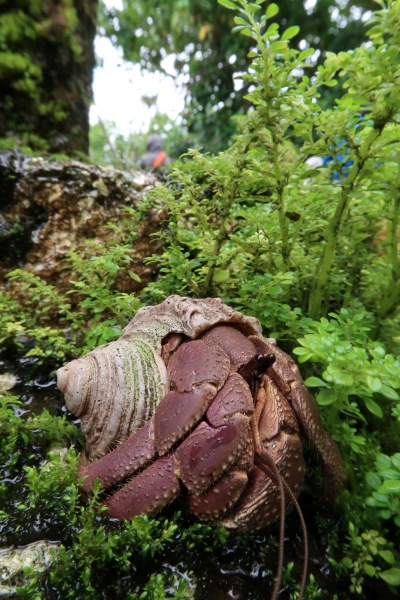
Struggling to hold back tears, I tenderly lifted my soulmate and placed her in the palm of my hand. Peering into her eyestalks, I could see that she was similarly devastated. Holding her pincer between my fingers, I whispered consoling words, knowing full well that my promises were empty. As the life boat whisked me away, I watched the elegant outline of her shell disappear into the rain.

I suppose it was doomed to fail from the beginning. I, a boy from a small town in West Michigan, and she, a stunning Palmyran Strawberry Hermit Crab.


Star-crossed, in every sense, yet connected by some deeper force. Even now, as our ship undertakes its journey northward, I scan the horizon for signs of her. My eyes are met with nothing but empty blue ocean. Such is the tragedy of the boy and the crab.

With great sorrow,

Dakota Riemersma

Monday, May 23, 2022

Palmyra Review

5/18: As we motored through the narrow channel into Palmyra’s west lagoon, we were greeted by a group of 6 Mantas performing barrel rolls along the port side of the RCS. A single grey reef shark swam a few meters alongside us just as we cruised out of the channel. Later that day, a few of us rode the defender to the the Nature Conservancy’s research station, where we took our first steps on land in 3 weeks. After hiking through sand flats filled with brilliant yellow butterfly fish, banded snake eels, and more hermit crabs than any of us had ever seen, we emerged out of the forest onto a pristine swimming hole. Maitri, Mark, and I snorkeled around the clearing, as Drive and Dakota took turns taking off a rope swing into the crystal-clear water. At one point, I climbed a slanted palm tree about 12 feet above the swimming area, and watched my first blacktip reef shark of the trip cruise directly beneath me, just a few feet from the swimmers. Our time on Palmyra would be very different from that spent on the high seas.


5/19: My second day in Palmyra was my first chance to snorkel the iconic reef. The first thing I noticed about the habitat was the incredible 3-dimensionality of the corals. In addition to being vibrantly colorful, the reef, which ranged from 0 to about 15 feet in depth, was characterized by unique and intricate geometries. My snorkel buddy Dakota and I first circled the boat, taking in the sensory overload of fishes, invertebrates, and coral that we had been waiting so long to see. However, as soon as we stared down our first subadult blacktip, we had a new goal - finding as many sharks as we could. In total, we counted around 9 sharks that day. My favorite encounter was a whitetip reef shark that I intersected as we each rounded the same patch of coral. I suddenly found myself just a few feet directly above the shark, and it allowed me to follow it from above for what felt like 2-3 minutes as it cruised through coral around our site.


After returning to the boat in the afternoon, Dakota, Mark, and I climbed onto the bowsprit, where we watched two mantas cruise directly beneath us. We watched the mantas circle around the boat and under us for thirty minutes, before heading below deck for dinner. Later that night, Sydney taught me how to extract DNA from a potential anglerfish sample that we had each placed bets on.

5/20: Hiking through the sand flats and forest of Strawn Island are what I will remember most about my time in the atoll. I spent my entire third day in Palmyra traversing the uninhabited island, and finding just about every terrestrial vertebrate Palmyra had to offer. As we motored toward the island, JP pointed out a turtle 15 feet off our boat, and I knew the day would be good. Hiking alongside the water, we were greeted by juvenile blacktips on our left, and dozens boobies on our right. At one point, hundreds of mullet began jumping out of the water. It looked as if one huge mass was galloping through reef, surely being chased by a hungry blacktip.

Diego helped identify nesting brown and masked boobies, and I took some of my favorite bird photos ever on the hike. He also spotted a small gecko just off the water, and I had the chance to get a photo I’ve been imagining for a while - a small lizard on a tropical coast, with palm trees in the foreground and untouched beaches in the background. Once we had spotted many more geckos and boobies, we emerged onto a larger sand flat from which we could see the RCS in the distance. Audrey met us for lunch, bringing apples, hard-boiled eggs, peanut butter, and honey. As we all wolfed down what felt like one of the best meals of our lives, Karthik (who had brought a plastic ziplock instead of a water bottle), Mark, and I tried our hardest to open coconuts on some rocks.


Soon, Chinmay, Matt, Mia, and Jenny arrived after a successful morning Manta mission. A few of us took temperature measurements throughout the sand flat for a fun project idea we had thought about while at Hopkins. Next, the group hiked through the forest and explored a series of World War II era bunkers. Inside one of them, we found the only mature coconut crab encountered on the trip. We were all really excited for Matt, who had been excited about seeing coconut crabs for many weeks, and happily shared all the facts he knew about their life cycle.

5/21: I finally got the chance to join Chinmay and Matt on a manta mission, and we set out with high hopes to deploy a net-tow, perform CTD-casts throughout the channel, and possibly see some mantas. Although no mantas made an appearance, we all had a great time. Barb cracked jokes as the net deployment turned out to be a failure. Chinmay, Anna, Matt, and I marveled at the groups of sharks that would circle our boat every time we stopped, dipping our heads into the water to spot blacktips, red snappers, and titan triggerfish from both up close and afar. I returned to the boat excited, but wanting more than ever to see new marine animals.

5/22: Before settling on studying white shark migration to Hawaii, Mia and I had planned to study how the thermal structure of sand flats influenced blacktip shark movement. Although we didn’t get to make it a full project, we were able to spend time on our second day at Strawn setting up some cameras and taking temperature measurements across the nearest sand flat. All the other Palmyra projects had made me jealous to do science around the reef, and sampling along our transect along the flat reminded me how much I love conducting field work, and how it helps me better appreciate interesting habitats. After the transect, we spent the rest of the morning further exploring Strawn. Camille collected coconuts to bring back to the boat, and JP ventured off to photograph boobies. 

5/23: My final day in Palmyra was spent appreciating the coral reef the atoll is so well known for. I departed for Penguin Spit (our most common snorkeling destination) with Matt, Chinmay, and Karthik, and we all formed a big snorkel group as soon as we got there. On my first snorkel trip, I felt overwhelmed with all the unfamiliar animals surrounding me. However, this time I was able to focus, and take everything in. We didn’t spot as many sharks this time, but we were able to marvel at a group of massive barracuda cruising through the reef, and schools of hundreds of fishes traversing corals.


Extra: Although we have left Palmyra - the pinnacle of our voyage, our days have been anything but devoid of action. A few days ago, Mark helped reel in a 100 + lb yellowfin yuna, and we tagged three yellowfin in total. It was my favorite day of the trip. To celebrate Ashely’s birthday, we had a meal of yuna prepared in three different ways, all of which were delicious. We recently found out that eDNA samples (tirelessly collected by Tanvi, Sydney, and Shaili) from along our cruise track included ghost shark, megamouth shark, thresher shark, mako shark, blue whale and other DNA. Today was Mia’s birthday, and we celebrated with cookies and ice cream. I also reeled in our first skipjack of the voyage, which later turned into a delicious poke.


Jaden Clark